 Imajourn
Patterns made by sound
When a vessel rings at one of its natural notes, the waves bouncing off its walls meet themselves and seem to stand still. This is a standing wave. Some places swing hard while others hardly move at all, and sand or light gathers on those still places, the nodes, drawing the figure.
In 1787 Ernst Chladni showed this by drawing a violin bow along the edge of a metal plate sprinkled with sand. Each note left a different figure, and they're still called Chladni figures. In 1967 the Swiss doctor and scientist Hans Jenny named the study of such patterns cymatics, from the Greek kyma, a wave.
Why the figures are symmetric
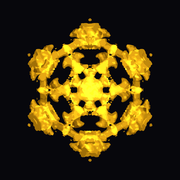
A figure takes on the symmetry of its vessel. In a hexagon the pattern tends to repeat six times around the centre, in a square four times, and a circle draws rings and spokes. That's why so many cymatic figures look like mandalas and rose windows: they share the same kind of symmetry.
Higher notes draw more intricate figures, with more rings, more petals and finer lattices. And not every note draws a clear figure, because a vessel rings strongly only at its natural notes, its resonances.
Make your own in Imajourn
- Choose a vessel. In Shape, pick the circle or any regular polygon, from a triangle to a dodecagon. They're all free; Imajourn Pro adds a heart, a star, a ring, an ellipse and more.
- Find its notes. Hum one steady note, or choose Tones in Sound and sweep the pitch strip. The notes where your shape resonates glow, and there the figure blooms.
- Weave a rosette. In Touch, set Symmetry to 2×, 3×, 4×, 6× or 8×. Every touch is repeated around the centre, and the ripples weave together.
- Ring a plate. Switch to Plate, and grains of sand leap from the moving parts and gather on the still lines, as in Chladni's experiments.
- See the map. With Imajourn Pro, the Energy view shows the standing wave itself: where the water swings hardest and where it stays still.
- Use your own shape. Draw a vessel in one stroke (free), or with Pro type a word or a name, use a photo of a drawing or import an SVG, and hear where it rings.
Choose the hexagon, hum a low note and hold it. Then go up a step at a time: each note that blooms draws a new six-fold figure.
In three dimensions
In Room PRO the same physics fills a sphere, a cube or a cylinder. Each note rings the space at one of its resonances, and points of light gather on the surfaces where the air stays still: nested shells, cones, petals and lattices, Chladni's figures in three dimensions.
Sacred geometry or physics?
Both, depending on how you look. The figures in Imajourn come from the wave equation, the same physics that shapes the sound of a drum, a bell or a room, and they're dependable: the same vessel and the same note always make the same figure. Whether you see a mandala, a lesson in physics, or both, is up to you.
Questions
What is cymatics?
The study of visible sound: vibration arranging sand, water or light into patterns. Hans Jenny named it in 1967, from the Greek kyma, a wave. Imajourn simulates the same wave physics on your iPhone or iPad.
Who was Ernst Chladni?
A German physicist and musician (1756–1827), often called the father of acoustics. In 1787 he published his experiments with sand on bowed metal plates, whose figures are still called Chladni figures.
Why do some notes draw no clear figure?
A vessel rings strongly only at its natural notes, its resonances. Between them the reflected waves don't line up, and the pattern keeps moving. In Imajourn, Tones lights up the notes where your shape resonates.
Can my name become a shape?
Yes, with Imajourn Pro: type a word and it becomes the water's vessel. Set it inside a circle or polygon and its outline becomes a wall, with water inside and around it.
Make your own figures
Imajourn is free to download and play on iPhone and iPad. Imajourn Pro is one purchase, never a subscription.